

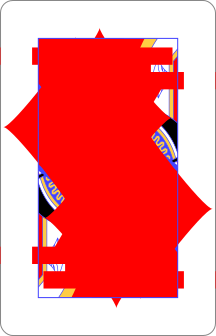
Imagine the dream hand:
Your only problem is finding out whether partner has the Ace of Hearts. Yes? You will play 7♠. No? You will play “only” 6♠. Easy.
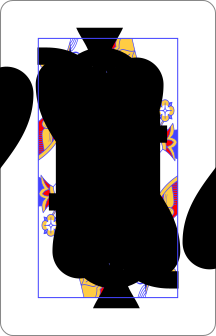
So you open 1♠. And, as usual, your partner holds:
So partner passes, since a response requires at least 5 HCP. You miss the small slam, stuck in 1♠. That is unfortunate. Let us see how to avoid it.
The 2♦ game-forcing opening
When you have at least 24 HCP or nearly enough for game by yourself, open 2♦. This is an artificial opening bid (it promises nothing in Diamonds) that commits your partnership to game unless you have doubled an opponent’s contract.
With no opposing intervention, partner opens 2♦, you respond 2♥, and partner then bids 2♠. With zero points and two Spades, may you pass?
Section quiz| South | West | North | East |
|---|---|---|---|
| 2♦ | Pass | 2♥ | Pass |
| 2♠ | Pass |
The responses? “The Ace’s suit,” as the saying goes:
| South | West | North | East |
|---|---|---|---|
| 2♦ | Pass | ||
| Possible responses — choose one line only | |||
| 2♥ | |||
| 2♠ | |||
| 2NT | |||
| 3♣ | |||
| 3♦ | |||
Learn more: weak hand
“Weak hand”: 7 HCP or fewer.
“Some strength”: 8 HCP or more.
After a game-forcing 2♦ opening, you hold 9 HCP, seven Clubs, but no Ace. Which response from the table do you choose?
Section quizIn our example, you would have opened 2♦, partner would have bid 2♥ (no Ace), and you would have bid 6♠. If partner had responded 2♠ (the Ace of Hearts), you would have bid 7♠. Usually, though, you will not move so quickly: once partner has shown any Aces after 2♦, simply bid 2NT (balanced hand) or your long suit at the lowest level (2♠, 3♣, 3♦…), and continue exchanging information.
The strong, unspecified 2♣ opening
For your convenience, there is an opening bid for strong hands that are not quite strong enough to open 2♦. Lucky you.
Use it when you have:
- either a balanced 22–23 HCP,
- or a good long suit (6 cards in a major, 7 in a minor) and 18 or 19 HCP, for example:
or
Open 2♣; this is called the “strong, unspecified 2♣ opening.” Like 2♦, it is an artificial bid and therefore promises nothing in Clubs.
The responses? There is only one: 2♦. It is a kind of waiting bid that asks opener to describe the hand. It is also artificial and promises nothing in Diamonds.
After that, calmly describe what you have:
| South | West | North | East |
|---|---|---|---|
| 2♣ | Pass | 2♦ | Pass |
| Possible responses — choose one line only | |||
| 2♥1 | |||
| 2♠2 | |||
| 2NT3 | |||
| 3♣4 | |||
| 3♦5 | |||
- South 2♥ 6 good Hearts, 18–19 HCP
- South 2♠ 6 good Spades, 18–19 HCP
- South 2NT Like a 1NT or 2NT opening, but with 22–23 HCP
- South 3♣ 7 good Clubs, 18–19 HCP
- South 3♦ 7 good Diamonds, 18–19 HCP
You open 2♣ with six good Hearts and 19 HCP. Partner responds 2♦. Which rebid describes the type of hand promised?
Section quiz| South | West | North | East |
|---|---|---|---|
| 2♣ | Pass | 2♦ | Pass |
The any-distribution double
Here is a similar situation: you have more than 18 HCP, but the opponents opened before you! The nerve. For example, imagine that you are West with:
The idea is to double first instead of bidding 1♠, then bid the Spades later. For example:
| South | West | North | East |
|---|---|---|---|
| 1♣ | Double | Pass | 1♥ |
| Pass | 1♠ |
roughly 18–20 HCP
After an opponent opens 1♣, you double with a very strong hand. Partner responds 1♥, and you then bid 1♠. Within the course framework, what additional information does this sequence convey?
Section quiz| South | West | North | East |
|---|---|---|---|
| 1♣ | Double | Pass | |
| 1♥ | Pass | 1♠ |
Your turn to play—and, as you might expect, you are going to have some strong hands. Great!